
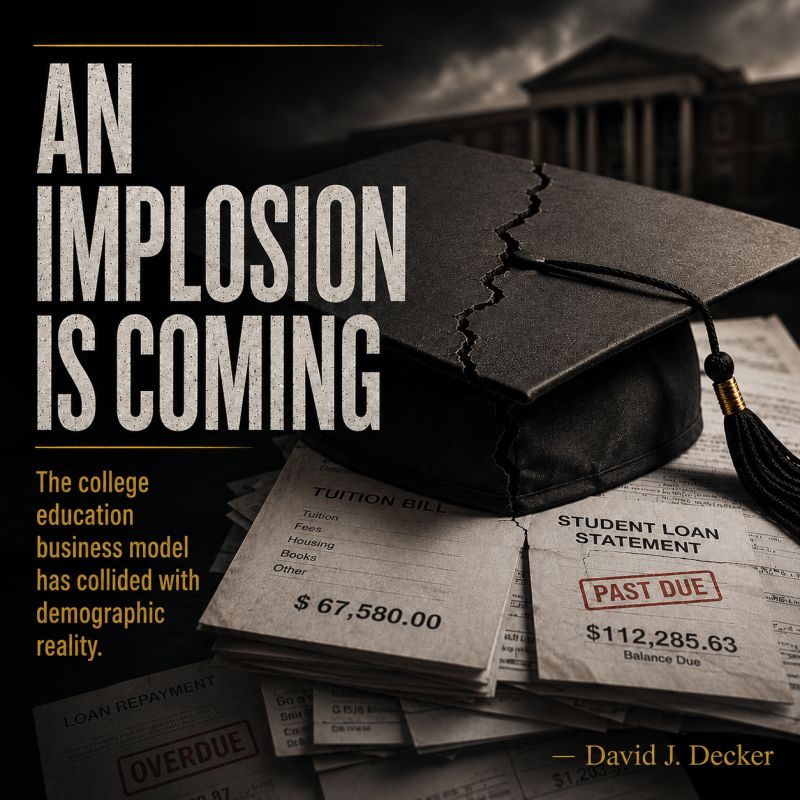
For decades, higher education operated with the confidence of a business model that seemed untouchable.
Enrollment would keep rising.
Student loans would always be available.
Parents would keep paying higher tuition bills.
And a college degree would guarantee economic mobility.
That entire framework is now colliding with reality.
An implosion is coming to higher education—not because education itself lacks value, but because the economics surrounding it are beginning to crack.
This is what I call a Reality Face Punch.
Demographics are one of the biggest drivers. Fewer traditional college-age students are coming through the pipeline in many parts of America. Birth rates have been declining for years, and colleges are now beginning to feel the impact. Many institutions built large administrative structures, expansive campuses, and growing budgets under the assumption that enrollment growth would continue indefinitely.
But reality doesn’t negotiate.
At the same time, the student loan equation is changing. Families are increasingly questioning whether it makes sense to borrow six figures for degrees that may not produce the economic return they once promised. That skepticism is spreading rapidly.
And honestly, it should.
For years, many colleges behaved as though cost no longer mattered. Tuition increases became almost automatic. Luxury dorms, climbing walls, massive administrative staffs, and endless campus expansion projects were justified because federal loans made the money available upfront.
But eventually every bubble encounters resistance.
We’re already seeing the warning signs:
- declining enrollment
- college closures
- layoffs and budget cuts
- mergers between struggling institutions
- growing public skepticism about the return on investment of certain degrees
This shift is bigger than education itself. It has the potential to reshape portions of the white-collar labor market.
For generations, a college degree functioned as an automatic sorting mechanism. Employers often used degrees as a default screening tool regardless of whether the degree itself directly related to the work being performed.
That assumption is weakening.
Companies are increasingly prioritizing measurable skills, execution ability, adaptability, and real-world performance over pedigree alone. In many industries, experience and demonstrated competence are beginning to outweigh credentials.
That doesn’t mean college becomes irrelevant.
Far from it.
There are still professions where advanced education remains essential—medicine, engineering, law, accounting, and many technical disciplines. Great universities will continue to thrive. Elite institutions with strong brands, endowments, and outcomes will likely become even stronger.
But the middle tier of higher education may face enormous pressure.
The dangerous part is that many institutions are still operating as though the old assumptions remain intact. They continue building budgets, staffing models, and tuition structures based on a world that may no longer exist.
History is filled with industries that ignored structural change until it was too late.
Newspapers believed classified advertising would last forever.
Taxi companies underestimated ridesharing.
Retailers ignored e-commerce.
Now higher education faces its own moment of reckoning.
The broader lesson applies far beyond colleges.
Any business model built on assumptions that are no longer true eventually encounters a Reality Face Punch. Leaders who fail to recognize changing conditions early often become victims of them later.
That’s why realism matters.
Reality is undefeated.
The future will belong to institutions—and individuals—that adapt faster than the marketplace changes around them.
Students will increasingly demand economic value. Employers will increasingly demand demonstrated capability. And colleges that cannot clearly connect cost to outcome may find themselves fighting for survival.
This transformation may take years to fully unfold.
But the early tremors have already started.