
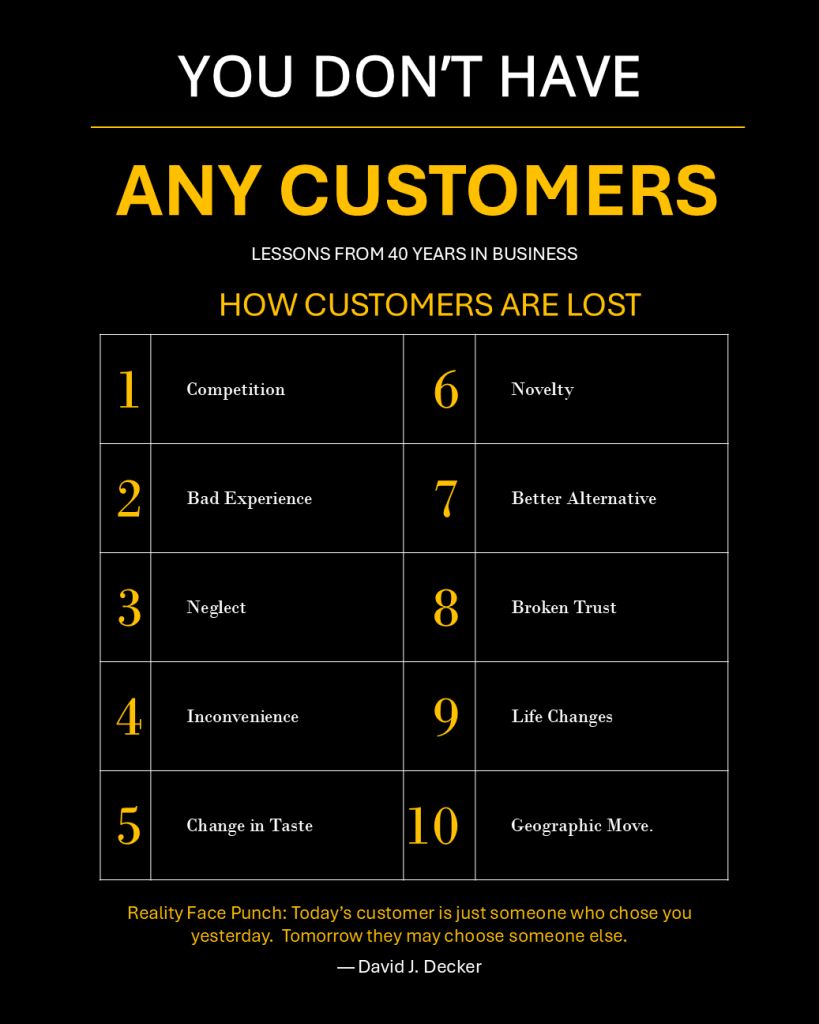
That statement sounds ridiculous.
I’ve owned and operated businesses for nearly 40 years. We serve thousands of residents, vendors, prospects, lenders, contractors, and business partners.
So how can I say we don’t have any customers?
Because the moment you start thinking in terms of “customers,” you risk missing something important.
You have people.
People with goals.
People with frustrations.
People with fears.
People trying to solve problems.
The word “customer” is useful for accounting. It is useful for marketing. It is useful for financial statements.
But it can also create distance.
A resident isn’t looking for an apartment. They are looking for a place to raise a family, start a new chapter, or simplify their life.
A prospect isn’t shopping for square footage. They are looking for certainty.
An employee isn’t looking for a paycheck. They are looking for opportunity, purpose, growth, or stability.
When businesses forget this, service deteriorates.
Processes become more important than people.
Policies become more important than outcomes.
Efficiency becomes more important than relationships.
The organizations that thrive understand something simple: people want to be understood before they want to be sold.
Over the years, I’ve discovered that many business problems are actually empathy problems.
The leasing agent who understands why someone is moving can often solve issues before they become objections.
The manager who understands what an employee is trying to achieve can often improve performance without creating conflict.
The business owner who understands what keeps customers awake at night can often outperform competitors without lowering prices.
Technology will continue to change how we communicate.
Artificial intelligence will continue to automate tasks.
But one thing isn’t changing.
People still want to feel heard.
They still want someone to understand their situation.
They still want to do business with organizations that treat them like individuals instead of transactions.
The companies that remember this will have a competitive advantage long after the latest technology trend has come and gone.
The reality is simple.
You don’t have customers.
You have people.
And the businesses that never forget the difference tend to win.